Modern lifestyle is filled with financial uncertainties and career pressures, along with family expectations and relationship strain, making stress and anxiety an everyday part of life. National estimates in India show that nearly 15% of adults experience mental health issues severe enough to require intervention. At the same time, 14 out of every 100 citizens have had a history of a mental disorder at some point in their lives.
This means that millions of Indians are affected by stress and anxiety, especially among urban and professional populations. A 2024 survey suggests that 1 in 2 Indians have experienced stress that impacts their daily life, highlighting how widespread emotional strain has become.
Traditional discussions about anxiety and stress often revolve around work, lifestyle, and relationships. However, there is also growing interest in how subtle energy patterns and emotional conditioning may influence our mental state.
Our past experiences and suppressed emotions often shape how we respond to situations and challenges, sometimes causing reactions that feel inconsistent, overwhelming, or difficult to explain. These are commonly referred to as emotional triggers, and they may operate at a subconscious level, making them harder to recognise or understand clearly.
In this blog, we explore whether aura scanning for anxiety can help individuals recognise emotional triggers, and how it relates to broader energy imbalances often associated with aura scanning for stress and aura scanning for depression.
Understanding Anxiety and Emotional Triggers
Anxiety can be defined as a state of worry, fear, or uneasiness that may or may not have an obvious cause. While some causes of anxiety, such as work pressure, relationship challenges, or financial concerns, can be easily identified, some emotional responses may arise from subconscious influences.
Emotional triggers are reactions to situations shaped by past experiences, unresolved conflicts, or repetitive thought patterns. A situation that may appear insignificant on the surface can cause a strong emotional reaction because it is linked to a memory or suppressed emotion. Over time, these responses can develop into recurring patterns of anxiety or emotional distress.
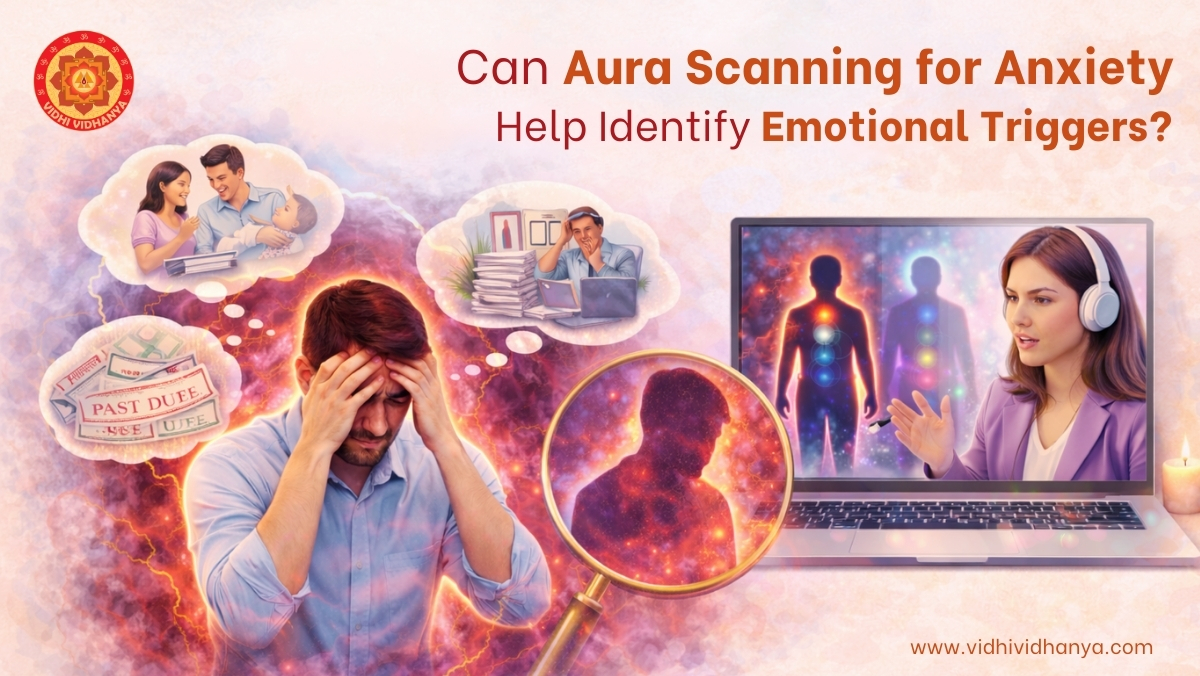
Practices such as aura scanning for anxiety are often explored as methods that may help individuals recognise emotional patterns that might otherwise go unnoticed. While conventional therapy focuses on analysing behaviour and psychology, certain alternative approaches, such as aura scanning for stress, attempt to observe how emotional disturbances may be reflected in energy imbalances around an individual.
What Is Aura Scanning and How Does It Reflect Emotional Patterns?
Aura scanning is a holistic practice which analyses the human energy field, often called the aura. This energy field is traditionally thought to represent a person’s emotional, mental, and spiritual condition.
Practitioners interpret aura patterns by observing energy density, and the consistency of energy flow. Irregularities or imbalances in these layers are believed to indicate emotional or mental strain. For example, disturbed or uneven energy patterns are sometimes associated with emotional exhaustion, while inconsistent energy flow may be linked to stress or anxiety responses.
Aura scanning for stress, anxiety, and depression is sometimes explored as a self-awareness practice that draws attention to emotional imbalances. Aura scanning for stress is often used to observe energy patterns linked to everyday stress or prolonged tension. When emotional heaviness persists over time, aura scanning for depression is sometimes explored to identify deeper emotional stagnation or suppressed feelings.
It is important to remember that aura scanning is considered a complementary spiritual practice and not a medical or psychological diagnostic tool.
How Aura Scanning for Anxiety May Help Identify Emotional Triggers
Identifying Repetitive Emotional Patterns
One of the key aspects often observed during aura scanning for anxiety is the presence of repetitive emotional patterns. Individuals who experience frequent anxiety, fear, or emotional instability may unknowingly develop behavioural responses influenced by subconscious triggers.
By analysing energy disturbances, aura scanning may help individuals recognise patterns associated with self-doubt, emotional dependency, or fear-based reactions. This can help individuals reflect on situations that repeatedly trigger anxiety.
Understanding Stress Responses
Emotional triggers are closely linked to stress responses. When stress accumulates over time, it may create energy imbalances that affect both emotional and physical well-being. Aura scanning for stress helps identify areas where energy flow appears restricted or overwhelmed due to prolonged pressure.
Recognising these patterns may help individuals understand how everyday stressors influence emotional responses and decision-making.
Recognising Suppressed Emotional Experiences
In certain cases, anxiety may be accompanied by deeper emotional heaviness. Aura scanning for depression is often explored to understand underlying emotional blocks linked to grief, disappointment, or unresolved emotional experiences.
While aura scanning does not directly identify the exact cause of emotional triggers, it is believed to highlight areas that may require emotional or spiritual attention.
Guided Interpretation and Responsible Practice
Interpreting energy patterns requires experience and emotional sensitivity. Structured aura scanning services, such as those offered by Vidhi Vidhanya, are conducted by trained professionals who help individuals understand their results responsibly and thoughtfully.
Signs Emotional Triggers May Be Linked to Energy Imbalances
Emotional triggers often manifest subtly in daily life. Individuals experiencing recurring emotional distress may notice:
- Sudden emotional overwhelm without a clear reason
- Repeated relationship conflicts or communication challenges
- Persistent anxiety despite stable external circumstances
- Frequent mood fluctuations or emotional fatigue
- Difficulty maintaining clarity in personal or professional decisions
Aura scanning for anxiety is often explored by individuals who experience these patterns but struggle to identify their emotional roots. Similarly, aura scanning for stress and aura scanning for depression are sometimes used to reflect on prolonged emotional strain and suppressed emotions.
How Aura Awareness Supports Emotional Well-being
Awareness is often the first step towards emotional balance. Aura scanning encourages individuals to reflect on their emotional reactions and behavioural patterns. By recognising energy imbalances, individuals may become more aware of their emotional triggers and decision-making tendencies.
Many individuals explore aura scanning for anxiety as a complementary practice alongside counselling, mindfulness, or spiritual guidance. Aura scanning for stress helps identify pressure patterns, while aura scanning for depression is often explored as a reflective practice for emotional healing and inner awareness.
The purpose of aura awareness is to encourage deeper emotional understanding and bring about conscious personal growth.
Structured Aura Guidance with Vidhi Vidhanya
For individuals seeking structured aura scanning, Vidhi Vidhanya offers services led by trained and qualified practitioners. Their approach combines spiritual understanding with systematic interpretation, enabling individuals to explore emotional triggers in a responsible, guided manner.
Conclusion
A single event rarely causes anxiety. It is often shaped by emotional memories, subconscious conditioning, and stress responses that develop over time. Emotional triggers can remain hidden, influencing behaviour and mental well-being without conscious awareness.
Aura scanning for anxiety helps individuals understand hidden emotional patterns by highlighting energy imbalances that may indicate emotional distress. When explored alongside aura scanning for stress and aura scanning for depression, it provides individuals with an opportunity to reflect on deeper emotional influences.